Happy VE Day

Following my own advice, I am celebrating Victory in Europe (VE) Day. On May 8, 1945, Nazi Germany (at this point commanded by Admiral Dönitz, as Hitler had committed suicide on April 30) signed the final surrender of its armed forces, ending the second world war in Europe. Here is the New York Times front page from that day
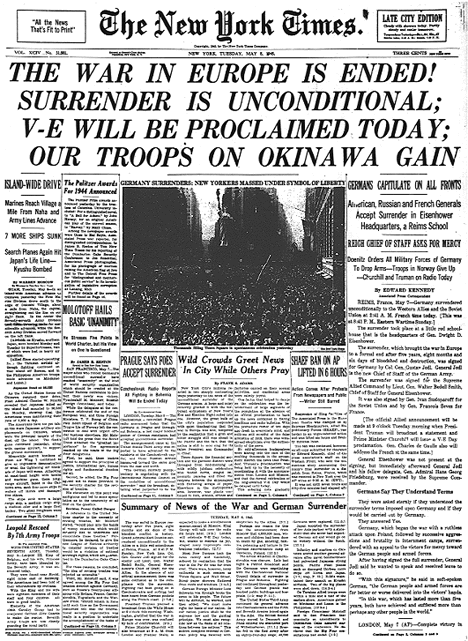
Two things strike me about the headline. (1) holy passive voice, batman, and (2) it ends with a stinger: an update on the campaign in Okinawa
Truman’s speech had a similar unresolved tone, describing a victory “only half over.”
We can repay the debt which we owe to our God, to our dead, and to our children, only by work, by ceaseless devotion to the responsibilities which lie ahead of us. If I could give you a single watchword for the coming months, that word is work, work, and more work. We must work to finish the war. Our victory is only half over.
Truman of course is referring to Japan, which would capitulate a few months later after it was nuked twice and saw the Kwantung Army disintegrate under a Soviet onslaught in a matter of a few days.
But we might regard even that victory as “only half over.” The things Nazi Germany and Imperial Japan represented – authoritarian government, blood sacrifice of the individual in service to the state, racial and ethnic supremacy, extreme partiality, slavery and looting as means of economic gain, and genocide are alive and well in this world. And I am not just talking about the obvious places.
We should remember VE Day not just because it is the anniversary of a glorious achievement by people in living memory (your parents, grandparents, or great-grandparents depending on your age), but because the job still isn’t done and we could do with an annual reminder. Perhaps some day we too will have a moment like Winston Churchill here where we deal these forces a setback worthy of the victory sign, although one hopes without the grinding warfare.
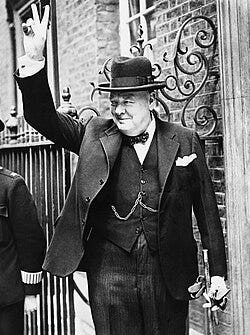
But until then, his speech contains good counsel as well (mutatis mutandis for our own point in history):
We may allow ourselves a brief period of rejoicing; but let us not forget for a moment the toils and efforts that lie ahead. Japan, with all her treachery and greed, remains unsubdued. The injury she has inflicted on Great Britain, the United States, and other countries, and her detestable cruelties, call for justice and retribution. We must now devote all our strength and resources to the completion of our task, both at home and abroad. Advance, Britannia! Long live the cause of freedom! God save the King!
Postscript: the thumbnail was created by Claude, where I asked for an image celebrating VE Day and an explanation of its design choices. For those interested, here is its rationale:
I’ll create a commemorative VE Day image — a dawn scene with a dove of peace, framed by Allied bunting.A few notes on the choices:
The dawn sky. I built the composition around a sunrise rather than full daylight or fireworks. May 8, 1945 was the morning Europe woke to the news — the gradient runs from deep indigo at the top through dusky purple and rose down to warm gold at the horizon, the visual moment when night ends but the day hasn’t fully arrived. It also reads as the ending of a long darkness, which felt right for a war that had cost so much.
The dove with the olive branch. The single most universal symbol of peace, predating WWII by millennia (Genesis, then Picasso’s 1949 lithograph cementing it as the modern shorthand). I placed it flying upward and to the right — a directional choice that reads as ascending and forward-moving in left-to-right reading cultures, rather than descending or static. It’s white against the dusky upper sky for contrast, but it’s flying just at the edge of the sun’s glow, which gives it the warm lit-from-below quality of something emerging into the light.
The bunting. Red, white, and blue triangular pennants because those were the colors of nearly every major Allied nation — Britain, the United States, France, the Soviet Union, the Netherlands. I avoided any single national flag specifically to keep it pan-Allied rather than centering one country. Bunting itself is the right artifact: the famous photographs of VE Day on Whitehall, in Times Square, in liberated Paris all show streets draped in it, hung hastily from windows the moment the ceasefire was announced.
The horizon and skyline. The silhouetted rooftops at the bottom anchor the scene in a place — a city at dawn, buildings still standing. After six years in which European cities had been bombed into rubble, an unbroken urban skyline at sunrise is its own quiet statement.
The typography. Georgia serif rather than sans, with the subtitle in italics. Serifs carry the editorial, commemorative weight you want for something historical; sans would have felt too contemporary, more like a flyer than a monument. The middot separator in “Victory in Europe · 8 May 1945” is restrained — a hyphen would have felt casual.
What I deliberately avoided. No weapons, no soldiers, no flags being raised, no specific real people. Those images exist and are powerful, but they’re also charged in ways that depend on which Ally’s perspective you take. A dove, a sunrise, and shared bunting felt like the most honest way to mark the day for everyone it concerned.
Very ecumenical of it.