The Red Button/Blue Button Question Resolved
Trust me, I am a decision theorist

Every so often, a poll like the below goes around social media:
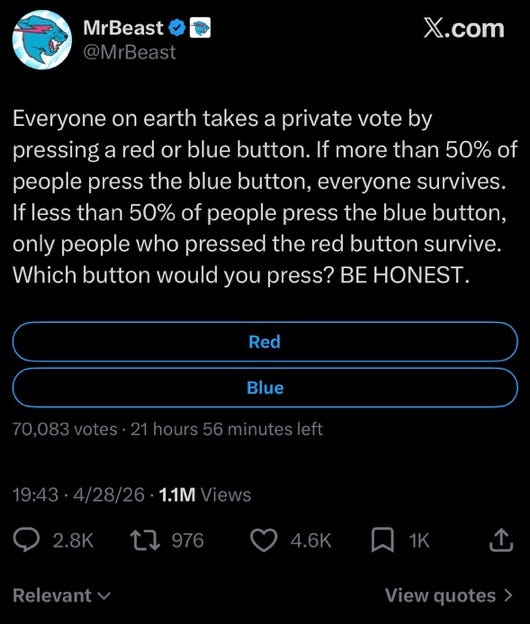
If you read the prompt, you will swiftly realize that there is exactly one reasonable option. Anyone who fails to notice this and boldly declares for the other one is obviously a gullible dumbass. The only problem (because this is a classic scissor poll): the internet is split over which option is Obviously Rational and which is For Gullible Dumbasses Only, which of course is why polls like this go around social media every so often in the first place. Before I reveal the right answer, let’s go over the arguments on each side.
The Case for Red
The case for red employs basic game theory. We have one significant uncertainty and one choice to make, which means we can lay out the options in a 2x2 matrix (with labels) and examine the potential consequences. Note that because Mr. Beast is not the most precise at wording things, I will assume an odd number of button-pressers.
Now is it not obvious?
Laid out as a payoff matrix, it is clear that Choose Red means you live come what may, while Choose Blue risks dying. Red possesses a property game theorists call weak dominance. In a game, an option R weakly dominates another option B just in case R yields just as good a result as B in every state and is better than B in at least one state. Weak Dominance is a pretty good claim to superiority. Dominance reasoning can go a bit wonky in infinite cases (see this paper), but none of that applies here. So, case closed, Red is the rational choice. Right?
The Case for Blue
Not so fast. I said there was disagreement. So, what do the Blue people have to say for themselves, advocating a dominated option like a bunch of weak losers?
Well, there is a tried-and-true way to attack a dominance argument. Point out that it leaves some considerations on the table. Once again, there is a classic case of this strategy: one boxing in the Newcomb Problem. In a Newcomb Problem, you face the following scenario:
You are confronted with two boxes, one of which is clear and the other of which is opaque. You can take either the opaque box and its contents or both boxes and their contents. In the clear box is $1,000. In the opaque box is either $1,000,000 or $0. If yesterday a preternatural predictor predicted that you would choose one box, the opaque box has the million. If, on the other hand, the predictor predicted that you would choose two boxes, the opaque box is empty.
If we set up another payoff matrix, we observe the following:
There is once again a clearly rational box
If we choose 2 boxes, we are richer come what may. Whatever the predictor predicted, we get the extra thousand by two-boxing. It possesses a property game theorists call strict dominance, which is Weak Dominance’s even more dominant older brother. Option A strictly dominates Option B just in case Option A is preferable to Option B in every state.
And yet there are one-boxers. Why? Well as these cheeky folks like to point out, you almost certainly will be richer if you’re a one-boxer. After all, the predictor is preternaturally good and can read a payoff matrix just as well as you can. They only put a million in the opaque box if they thought you were the kind of quirky who chooses a dominated option, and they are usually right.
A little more officially, one-boxers point out that the most straightforward application of expected utility theory says that the expected utility of one-boxing beats that of two-boxing, because the situation exhibits a fancy kind of act-state dependence that simple matrix payoff models do not capture. I’m not taking sides in the Newcomb Problem here. The main point is illustrative: you can attack a dominance argument by trying to show that the payoff matrix at its base has omitted relevant considerations.
Back to our buttons. Team Blue points out that other people’s lives might matter, and since we all live if enough press blue, that really should be in the payoffs somehow. After all, everyone in the world has to press a button, including people who might goof up. To misquote (maybe apocryphal) Bismarck, won’t someone think of drunkards, fools, and the United States of America? (the form of color-blindness where we confuse red and blue is pretty rare, but severe forms of Protanopia can make it happen; maybe the polling bureau has a high-contrast option?[1]).
To really assess this argument, we would need an expectation for the percentage who choose blue, a utility number for the collective lives of the blue-choosers, a way to weigh this against our own life, and an expectation of our choice being the difference between blue-life and blue-death. It’ll get complicated fast, and it might depend on framing effects (see Richard Chappell’s discussion here).
A second Blue argument appeals not to the utility of actually saving the lives but to the value of signaling that you are altruistic. By choosing Blue, you signal that if there are drunkards, fools, or Americans out there who can’t read a payoff matrix, you are there for them. As one quippy tweet (that annoyingly I forgot to screenshot) put it: “I choose Blue because if only the Reds survive, I don’t wanna share a planet with them.”
This argument is not as good, for a relatively simple reason. The vote is private. This matters – whether votes are public or private makes a huge difference to what the rational move may be, especially if they are conducted sequentially (for fun some time, read up on information cascades; even Superbaby-tier Bayesian can get caught up in them). If the Blues make it, I can get all the signaling benefits of Blue by just lying about it, and if they don’t, we all equally choose Red. It’s a built-in Ring of Gyges.
About That Answer
So, who has the upper hand? Well, before I reveal the truth, a simple observation. We don’t actually have a red or blue button to push. The decision before us is whether to announce ourselves as Team Red or Team Blue. And this has very different payoffs. By announcing Team Red, you’re telling the world that you can read a payoff matrix. By announcing Team Blue, you are signalling that you are an altruistic cooperative sort who is there for the drunkards, fools, and Americans of the world. You can probably also read a payoff matrix, because that’s easy and you’re deep enough into this discussion to be announcing a side. Ready for the answer?
.
.
.
.
.
.
.
.
.
.
.
.
.
.
.
.
.
.
.
.
.
.
.
Blue of course.
[1] Fortunately, the author is only blue-yellow colorblind but is an American so might be at risk.
Agreed! And I really like your connection to Newcomb's Problem.
One other argument for Blue, without assuming Evidential Decision Theory, which you also allude to, is to assume you care about saving as many lives as possible, and then reframe the problem as a collective action problem. I arrive at roughly the same conclusion that you do here:
https://firdausgupte.substack.com/p/why-you-should-push-the-blue-button
This was one of your very best, I thought. Super well-explained, well-paced, and funny.